
Audi OEM Engine Repair Parts Guide for Maintenance and Performance
Audi engine issues often begin with small signs: a coolant smell after parking, a warning light, oil collecting around the valve cover, a cold-start exhaust tick, or rough running under load. For Audi enthusiasts and DIY luxury owners, the right repair starts with precise diagnosis and OEM-fit components that match the engine, trim, and production details.
Audi engine symptoms can point to several different repairs.
Modern Audi engines rely on tight tolerances, controlled cooling, sealed oil passages, and emissions systems that work together. A small leak, worn gasket, weak cooling component, or exhaust restriction can affect performance and reliability. Guessing can lead to repeat repairs, especially when aftermarket parts do not match the original fit, material, or connection points.
Why OEM precision matters when Audi engine systems work together.
Audi engine repairs are rarely isolated. Gaskets seal oil, coolant, intake air, and exhaust flow. Cooling parts help protect aluminum engine components from heat stress. Exhaust and emissions parts support drivability and system monitoring. Choosing OEM parts helps maintain the fitment accuracy Audi owners expect, while reducing the chance of installation issues caused by poor sealing surfaces, incorrect dimensions, or incompatible connections.
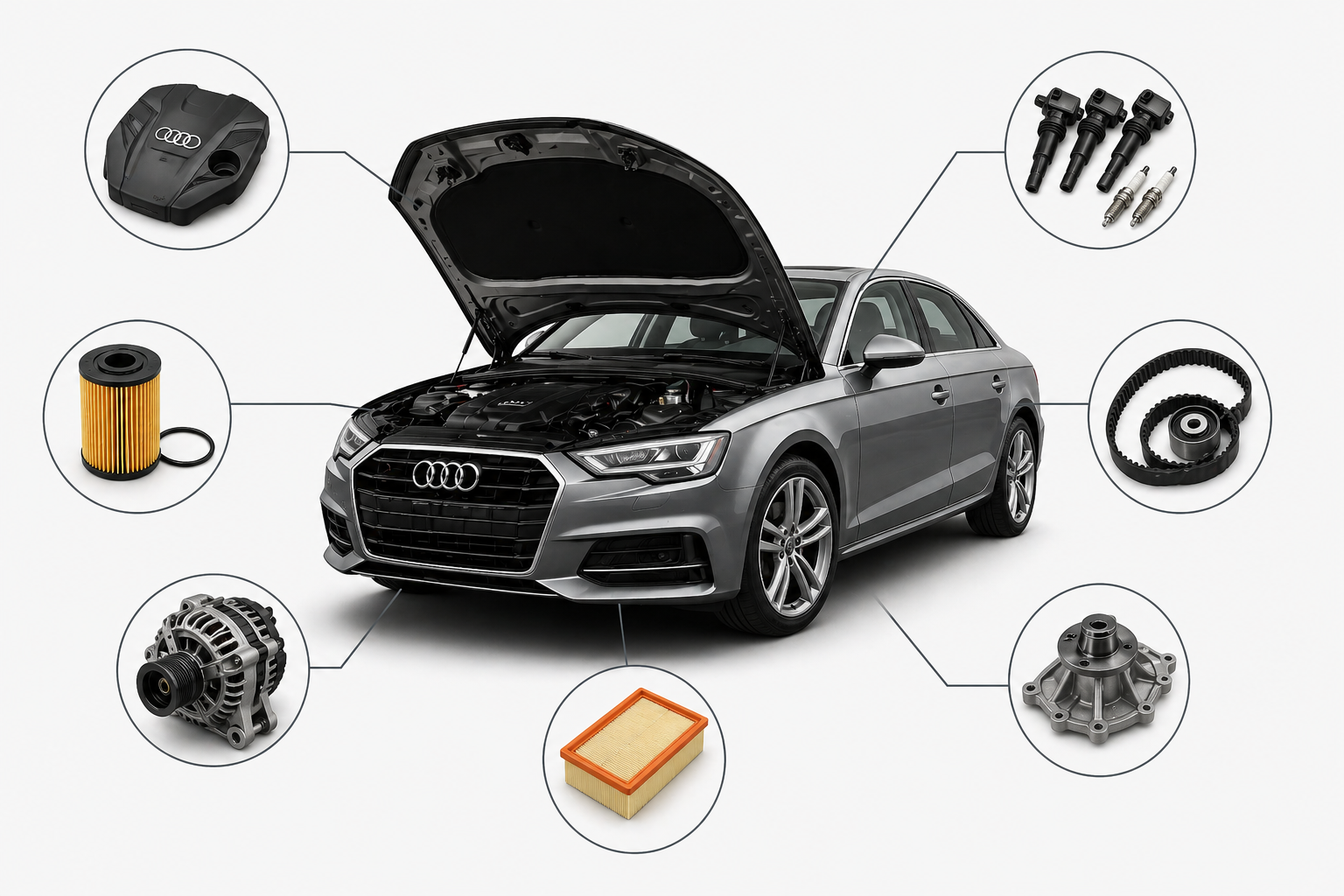
Follow this step-by-step path before ordering Audi engine repair parts.
- Identify the symptom. Note oil spots, coolant loss, overheating, smoke, exhaust odor, warning lights, rough idle, or power loss.
- Check when it happens. Cold-start noise may point toward an exhaust gasket or manifold concern, while rising temperature under load may suggest a cooling issue.
- Inspect visible service points. Look around the oil cap, oil pan, gasket areas, belts, pulleys, coolant hoses, exhaust joints, and emissions connections.
- Match the repair to the system. Separate sealing problems from cooling, exhaust, emissions, or internal engine concerns before buying parts.
- Confirm fitment by VIN. Audi model year, engine code, drivetrain, and trim can change part compatibility.
- Replace related wear items when practical. During teardown, it can be more efficient to refresh nearby seals, gaskets, or hardware rather than reopen the same area later.
- Refill and test carefully. Use correct fluids, bleed cooling systems as required, and verify there are no leaks, warning lights, or abnormal noises after repair.
Recommended OEM parts for Audi engine repair and maintenance.
For leak and sealing repairs, start with Audi full gasket sets when the engine is already open or multiple seals need attention. Use Audi exhaust gaskets for ticking, odor, or noise near exhaust joints. For oil service points, inspect Audi oil filler caps and Audi oil pans when you see seepage, damaged threads, or impact wear.
For accessory-drive and internal engine service, review Audi belts, pulleys, and brackets, Audi engine block parts, Audi crankshaft parts, and Audi pistons, rings, and rods. If damage is extensive, an Audi complete engines option may be the more practical repair path.
For temperature and fluid concerns, shop Audi cooling system parts and the correct Audi antifreeze. For exhaust flow and emissions-related repairs, check Audi exhaust manifolds and headers, Audi catalytic converters, Audi EGR valve parts, and Audi smog air pumps.
Frequently Asked Questions
How do I know whether my Audi needs gaskets or a larger engine repair?
If the issue is limited to visible seepage or a single sealing area, a gasket repair may be enough. Compression loss, heavy smoke, metal noise, or repeated overheating may point to internal engine damage that needs deeper inspection.
Why should I use OEM Audi engine parts instead of aftermarket options?
OEM parts are built for Audi-specific fitment, sealing points, mounting locations, and system compatibility. That precision is especially important on engines where small dimensional differences can cause leaks, noise, or repeat labor.
Can I choose Audi engine parts without a VIN?
You can browse by category, but VIN confirmation is strongly recommended before purchase. Audi engine codes, trims, and production changes can affect which part fits correctly.
When should I consider a complete Audi engine?
A complete engine may be practical when internal damage affects several major components or when labor and parts costs make a full assembly more efficient than rebuilding individual areas.